

DigInTraCE Digital Tools and Platform Development
Abstract
Digital Product Passports can support circular value chains by providing structured information about a product’s identity, origin, composition, processing history, environmental performance and end-of-life options. However, circular value chains involve continuous transformations: materials are sorted, upgraded, incorporated into new products, repaired, reused and recycled. Their digital records must therefore evolve together with the physical products and materials.
DigInTraCE addresses this requirement through a dynamically updated Digital Product Passport, integrated into the project’s Decentralized Traceability Platform. The DPP receives information from sensing and sorting systems, Smart Tags, production systems, mobile applications, environmental assessments and blockchain-based traceability services.
To make this information easier to understand and use, the project has also developed a Mixed Reality Enabler, combining a mobile Augmented Reality application with a headset-based Mixed Reality application. These tools allow users to access product information, visualize product composition and traceability, and receive interactive Right-to-Repair guidance.
Together, the DPP and MR Enabler demonstrate how trusted product data can be transformed into accessible and actionable information for industrial actors, consumers, repair professionals, researchers and other value-chain stakeholders.
From Static Product Records to Dynamic Passports
A conventional digital product record usually describes a product at a specific moment, for example when it leaves the manufacturing facility. This approach is insufficient for circular value chains, in which the product or material may subsequently undergo several transformations.
A secondary raw material may be collected, inspected, sorted, cleaned, processed and incorporated into a new product. A finished product may also be repaired, disassembled or recycled. Each of these events changes the information that should be associated with the product.
The DigInTraCE DPP is therefore designed as a dynamic digital representation of a product, intermediate product or material stream. It stores information related to identity, origin, composition, processing, quality, sustainability, circularity and lifecycle events, while preserving the history of the product as it moves through the value chain.
The final implementation represents a transition from an initial DPP concept to a demonstrator-oriented digital tool. Its main developments include:
- An updated and more flexible DPP data model
- Defined user roles and access rights
- Role-dependent information views
- Deployment of DPP and traceability chaincode
- API integration with other digital tools
- Backend-driven mobile application content
- Support for sustainability and circularity information
These developments position the DPP as one of the central components of the DigInTraCE digital ecosystem.
The DPP within the DigInTraCE Platform
The DigInTraCE DPP does not operate as an isolated database. It connects physical materials and products with the project’s digital traceability infrastructure.
Its architecture can be understood through several interconnected layers.
The physical and operational layer represents materials, products, production processes, sorting activities and logistics events. The data-acquisition layer captures information from sensing and sorting systems, Smart Tags, production equipment, mobile devices and operators.
An integration layer then receives and validates information submitted through APIs, middleware and industrial communication mechanisms. The resulting information is stored in the DPP data layer, which contains product identity, composition, process history, sustainability indicators and lifecycle events.
A trust and ledger layer, supported by blockchain and Distributed Ledger Technologies, provides integrity and auditability for selected traceability records. Finally, the application and stakeholder layers make DPP information available through mobile applications, dashboards, environmental tools and Mixed Reality visualizations, according to each user’s role.
This modular architecture allows the same DPP framework to support different materials, products, demonstrators and stakeholder groups without requiring a separate system for every use case.
What Information Does the DPP Contain?
The DigInTraCE DPP data model combines common information categories with pilot-specific extensions.
Typical information includes:
Identification data, such as product, unit, batch and Smart Tag identifiers.
Origin and custody data, covering suppliers, source materials, locations, logistics and custody-transfer events.
Composition and material data, including material type, recycled content, additives, contaminants and other product-specific properties.
Process history, describing production, sorting, treatment and transformation steps.
Quality and certification information, including classification results, quality checks, validation status and certificate references.
Sustainability and circularity information, such as LCA indicators, environmental metrics and reuse or recycling potential.
Governance metadata, including data ownership, access levels, update history and ledger references.
The model is sufficiently generic to support all four DigInTraCE demonstrators while allowing sector-specific information for wood composites, recycled polymers, textiles and injection-moulded products.
Concrete DPP examples have already been prepared for intermediate and final products, including resins, particleboard, plywood, furniture, recycled PET materials, textiles and injection-moulded products.
How the Dynamic Update Mechanism Works
The DPP evolves as the associated product, or material progresses through the value chain.
An update may be triggered by:
- A sensing or sorting result
- A Smart Tag or QR-code scan
- A manufacturing or logistics event
- A mobile application interaction
- An API call from another digital tool
- An environmental or economic calculation
- A simulation-based traceability event
The system distinguishes between measured, manually entered, calculated and simulation-derived data. This distinction improves transparency by showing how each value was generated and what level of confidence can be associated with it.
Before an update is accepted, the system can check the source, format, timestamp, product association and consistency of the submitted information. Relevant events may also be connected to blockchain transaction references.
This approach supports reliable lifecycle traceability while allowing information to originate from heterogeneous industrial and digital systems.
Trusted and Role-Based Access to Information
Not every stakeholder needs access to the same level of detail.
A consumer may need general information about product identity, origin, sustainability and repairability. An industrial operator may require process history and material composition. A technical partner may need sensor results and validation flags, while a certification organization may require verified events and ledger references.
The DigInTraCE DPP therefore supports several information views:
- A summary view for public or non-technical users
- A traceability view for value-chain actors
- A technical view for authorized technology partners
- A sustainability view for LCA specialists and pilot owners
- An audit view for certification and standardization actors
Role-based access helps balance transparency with the protection of confidential industrial information. Blockchain and DLT services contribute to data integrity and auditability, while secure APIs determine who can view, update or validate each type of information.
The mobile application also uses backend-driven rendering. Its tabs, information categories and available functions can therefore change according to the active product and user role, rather than being permanently hard-coded for a single demonstrator.
Transforming DPP Data through Mixed Reality
Structured product data is essential for interoperability, but it may not always be easy for end-users to interpret. The DigInTraCE MR Enabler addresses this issue by presenting DPP information through interactive and immersive interfaces.
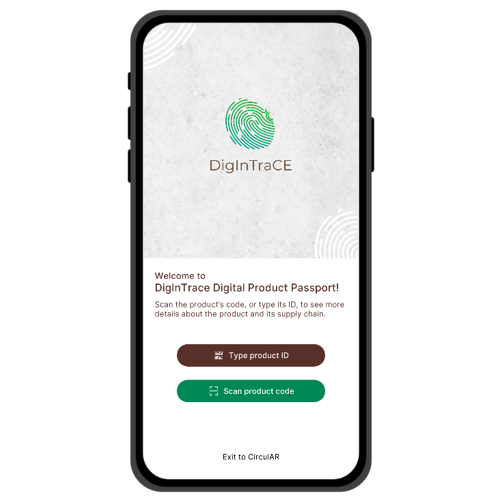
DigInTraCE DPP mobile app
Figure 1. Home screen of the DigInTraCE Digital Product Passport mobile application, allowing users to access product information by scanning a QR code or entering a product ID.
The module consists of two applications:
- A mobile application using Augmented Reality and 3D visualization
- A Mixed Reality application designed for head-mounted displays
Both applications retrieve information associated with a product’s DPP. A user can identify a product by scanning its QR code or entering its product ID. The system can then display product information, 3D models, circularity and sustainability data, certificates, traceability records and a product-composition tree.
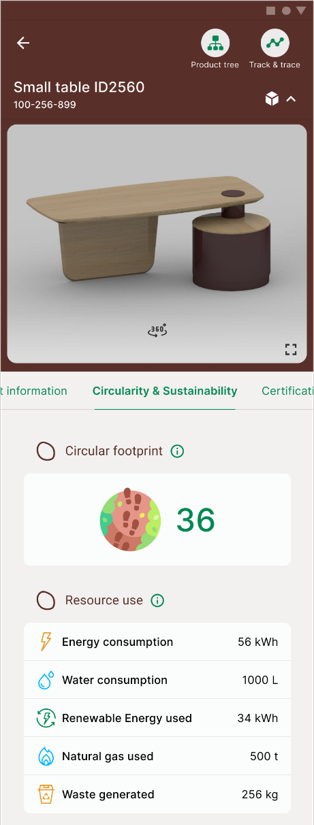
DigInTraCE Digital Product Passport
Figure 2. Example of the DigInTraCE mobile application displaying a Digital Product Passport with circularity indicators, sustainability metrics and navigation through the product traceability structure.
The mobile application, developed within the Unity environment and accessible through the CirculAR platform, supports Android and iOS devices. Users can also access recently viewed products, change their assigned role or language, and navigate between connected DPPs through the product tree.
The product tree is particularly useful for products composed of multiple materials or intermediate products. It allows users to navigate from the final product to the DPPs of its components, making product relationships more understandable.
The MR headset application adds spatial interaction. 3D objects, instructions, animations and highlighted components can be positioned directly within the user’s physical environment. The current implementation has been tested in the Meta Quest ecosystem and uses the Unity XR framework, which creates opportunities for future deployment on other compatible XR devices.
Supporting the Right to Repair
One of the most practical applications of the MR Enabler is the provision of interactive Right-to-Repair guidance.
Two furniture-repair scenarios have been developed:
- The first guides users through the repair or replacement of a damaged table leg. It covers inspection, removal, cleaning, alignment, reinforcement, fixation and curing.
- The second supports the restoration of a scratched wooden surface. It presents the main steps for cleaning, sanding, applying filler, smoothing, staining and adding a protective finish.
The guidance is provided through spatial 3D models, virtual tools, animations and contextual instructions.
The same content can be visualized either through an MR headset or through the CirculAR mobile application in AR mode. This makes the solution accessible both through specialized immersive equipment and through widely available smartphones.
By combining product-specific information with interactive instructions, the DPP becomes more than an information repository. It becomes an interface through which users can take actions that extend product lifetime and reduce unnecessary disposal.
Validation across the DigInTraCE Demonstrators
The DPP is being applied across four DigInTraCE demonstrators.
The Greek demonstrator connects agricultural and wood by-products with resins, panels and furniture. The Spanish demonstrator addresses the classification and reuse of wood residual streams. The Belgian demonstrator traces recycled PET through decontamination, upgrading and textile production. The Italian demonstrator connects recycled polymers with injection moulding, production data and optimization tools.
The main validation criteria include:
- Creation of DPP records for intermediate and final products
- Live or event-based updating
- Role-based access
- Blockchain integration
- Correspondence with real pilot data
- Connection with environmental indicators
- Understandable and stable user interfaces
- Harmonization of common DPP fields across demonstrators
This validation approach examines both the technical operation of the DPP and its ability to support different industrial sectors.
Conclusion
The DigInTraCE DPP and MR Enabler demonstrate how product traceability can be connected with accessible, human-centred digital services.
The dynamically updated DPP follows products and materials through processing, sorting, reuse, repair and recycling activities. It combines information from sensing systems, industrial processes, environmental assessments, mobile applications and blockchain-supported traceability.
The MR Enabler transforms selected DPP information into interactive product visualizations, composition trees, traceability views and repair guidance.
Together, the two solutions connect:
physical lifecycle events, structured product data, trusted traceability and human interaction.
This combination allows the Digital Product Passport to support not only regulatory information and transparency, but also industrial decision-making, training, maintenance, repair and product-life extension. The DigInTraCE implementation therefore provides a practical foundation for future circular-economy services in which product information remains connected to both the physical value chain and the people using, repairing and managing the product.