

The DigInTraCE project has developed an advanced online Life Cycle Assessment (LCA) computation tool designed to support standardised environmental and circularity assessments within Digital Product Passports (DPPs). The tool enables companies to model product systems, calculate environmental impacts, and evaluate circularity performance through a structured and user-friendly digital workflow. The implementation follows internationally recognised standards and methodologies, including ISO 14040/14044, the Environmental Footprint (EF) 3.1 methodology, and EN 15804 modular reporting principles, ensuring methodological consistency, transparency, and comparability of results.
A key strength of the tool is its hybrid modelling framework, which combines user-defined foreground data with background datasets from Ecoinvent v3.10. Users can define product systems by introducing information related to product composition, manufacturing processes, energy and water consumption, transport, waste generation, and end-of-life scenarios. The tool structures this information into a complete Life Cycle Inventory (LCI), enabling automated environmental and circularity calculations across the full product life cycle.
The modelling framework supports cradle-to-grave assessments by default and aligns results with the EN 15804 modular structure (A1-C4), allowing impacts to be analysed across different life cycle stages, from raw material extraction and manufacturing to use and end-of-life treatment. This modular approach facilitates hotspot identification and supports more detailed interpretation of environmental performance.

Figure 1. Overview of the LCA tool interface showing the modular life-cycle stage structure
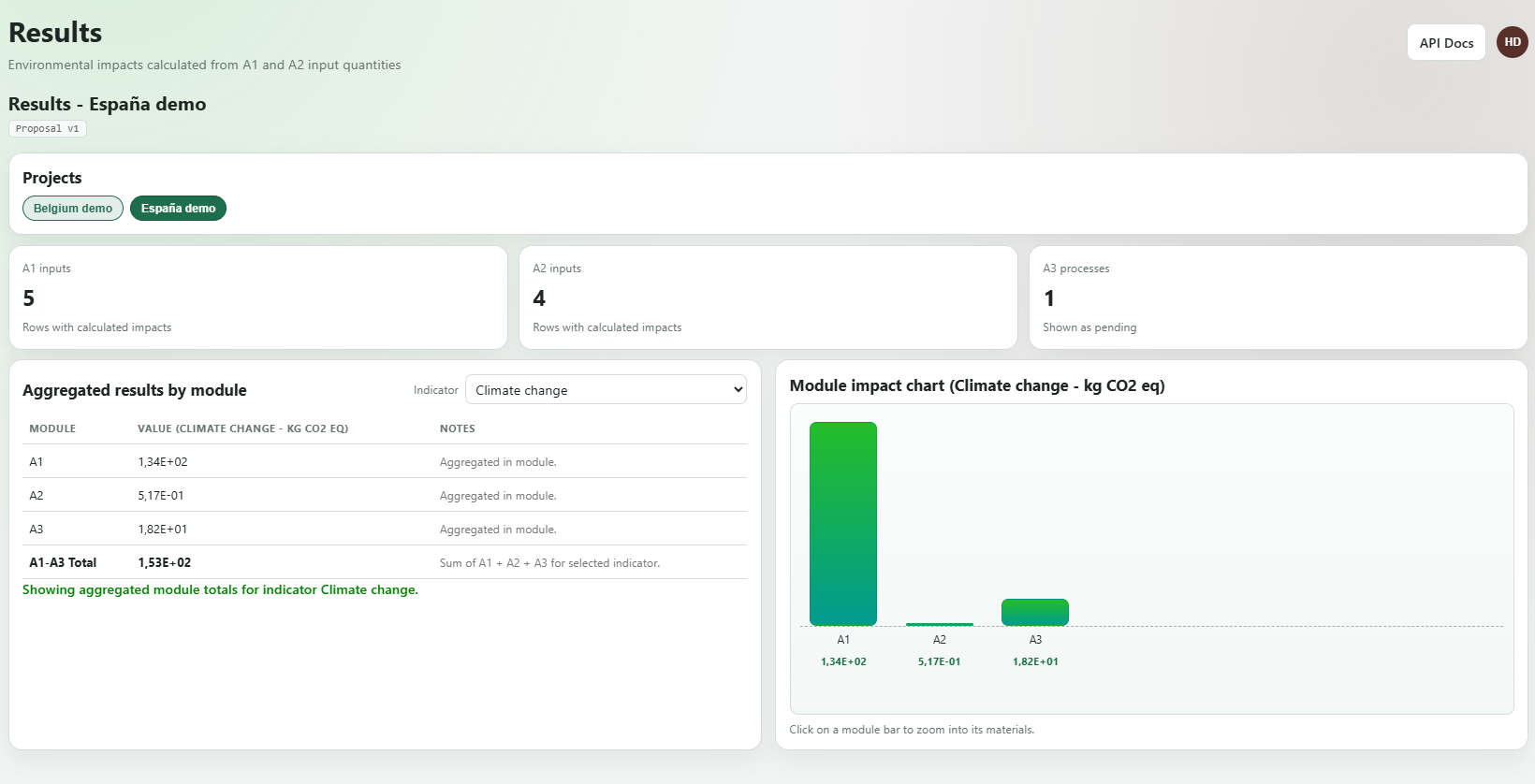
Figure 2. Overview of the LCA tool interface showing the modular life-cycle calculations
Beyond conventional LCA, the DigInTraCE tool integrates circularity assessment indicators to provide a broader sustainability perspective. In addition to EF 3.1 environmental midpoint indicators, the system calculates recycled content (R1), recyclability rate (R2), and the Material Circularity Indicator (MCI), combining the Circular Footprint Formula (CFF) approach with the Ellen MacArthur Foundation methodology. This allows users to assess not only environmental impacts, but also the circular performance and material efficiency of products and processes.

Figure 3. Overview of the information for the DPP, obtained from the LCA calculation
The tool has been successfully validated across the four DigInTraCE demonstrators, demonstrating its robustness, scalability, and applicability under diverse industrial conditions. In the Belgian demonstrator, the tool supports the assessment of recycling and upcycling pathways for polyester (PET) textiles, including the integration of recycled materials into new textile products. The modelling framework enables the evaluation of recycling efficiencies, material recovery processes, and end-of-life scenarios, providing a comprehensive assessment of both environmental impacts and circularity performance.
Validation activities have also been conducted in the remaining three demonstrators. The Greek demonstrator focuses on bio-based adhesives and wood composites derived from renewable and secondary raw materials; the Spanish demonstrator addresses the valorisation of wood-processing residues within circular wood value chains; and the Italian demonstrator evaluates recycled plastic components for automotive applications. Collectively, these demonstrators confirm the flexibility of the tool and its ability to represent a wide range of industrial systems, material flows, and circularity strategies while preserving methodological consistency and comparability of results.
By integrating Life Cycle Assessment and circularity evaluation into a unified digital framework, the DigInTraCE tool provides companies with a practical and scalable solution for assessing product sustainability, supporting environmental transparency, and enabling interoperable Digital Product Passports. The platform supports more informed decision-making regarding materials, manufacturing processes, recycling strategies, and end-of-life options, contributing to more circular and data-driven industrial value chains.